Disclaimer: This article was written in tight collaboration with an AI for Research and Editorial Support.
Have you ever wondered what it really felt like to live through a technological revolution? Not the sanitized version you read in history books, but the raw, messy, human experience of watching your world transform before your eyes?

I’ve been thinking about this a lot lately, especially as I watch friends and colleagues struggle with AI changing their jobs. It’s gotten me wondering: are we really that different from the factory workers of the 1800s who watched steam-powered machines change everything? Or the office workers of the 1980s who suddenly had to learn how to use computers?
The truth is, behind every technological leap forward, there are real people with real stories. People like 9-year-old Violet Hodges, who worked 14-hour days in a factory during the Industrial Revolution, or 22-year-old Sharanya Battacharya, who lost 90% of her income when her clients switched to ChatGPT. Their experiences remind us that technological progress isn’t just about machines and algorithms: It’s about human lives being turned upside down and rebuilt.
The First Wave: When Machines Invaded the Workshop
Let me take you back to 1811. Imagine you’re a skilled textile worker in England. You’ve spent years perfecting your craft, and your livelihood depends on the intricate work your hands can do. Then, seemingly overnight, machines arrive that can do your job faster and cheaper. What would you do?

This wasn’t just an abstract economic shift – it was deeply personal. Take Anna Brown, an 11-year-old who worked in a match factory. She witnessed a coworker lose her fingers to machinery, and the trauma stayed with her: “I could barely catch a glance of her hand… I don’t think anything could erase the screams from my mind now.”
The Luddites, those famous machine-breakers, weren’t just anti-technology extremists. They were people watching their world disappear. But here’s what’s fascinating: while they were destroying the looms, something else was happening. New jobs were being created. Factory supervisors, machine operators, transportation workers – roles that hadn’t existed before suddenly became essential.
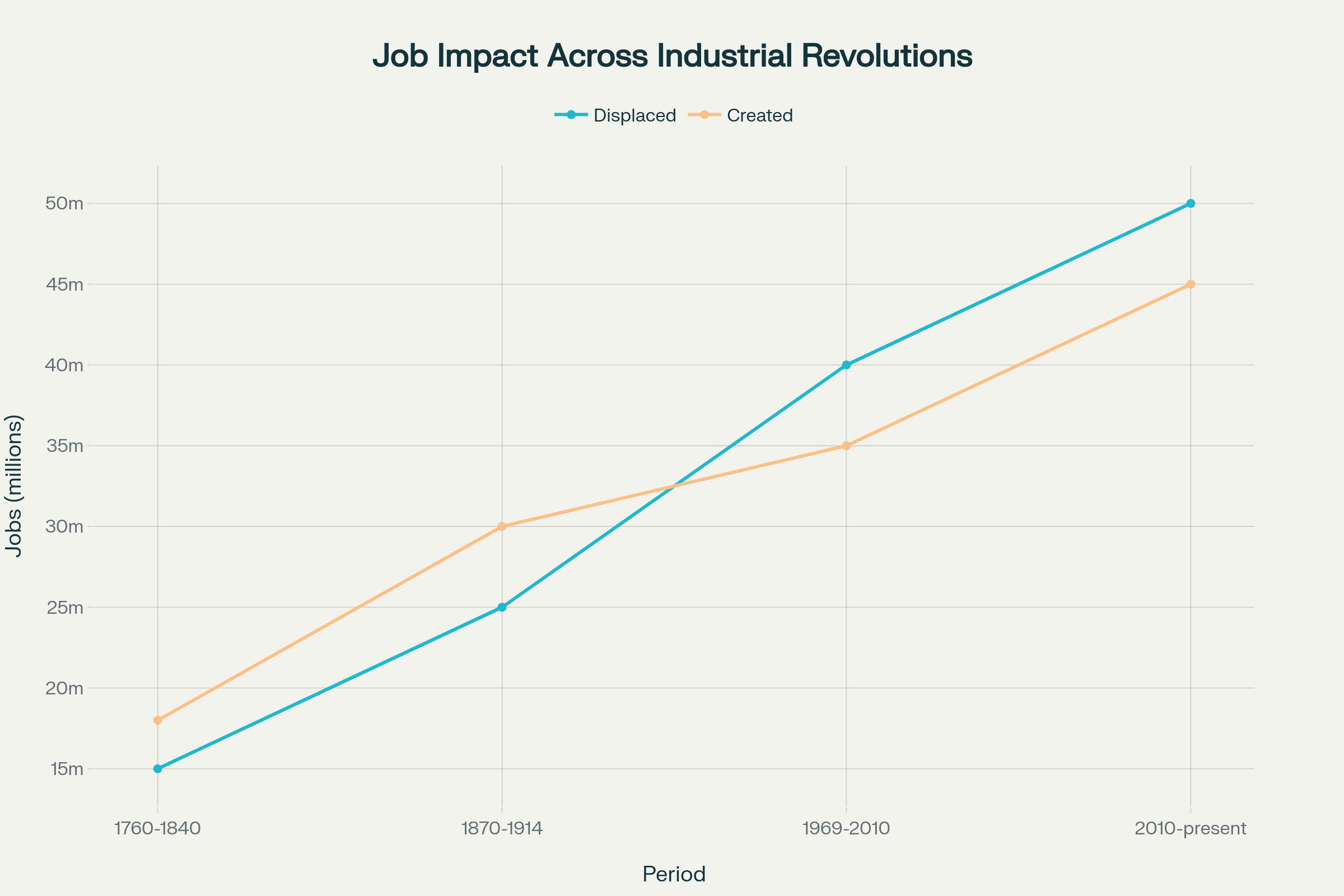
The numbers tell part of the story, but they can’t capture the human drama. Between 1760 and 1840, millions of people left their rural homes for industrial cities. Families were separated. Children worked alongside adults in dangerous conditions. But for many, it also meant steady wages for the first time in their lives.
The Second Revolution: Assembly Lines and New Possibilities
Fast forward to the early 1900s. Henry Ford’s assembly line didn’t just change how cars were made—it fundamentally altered what it meant to be a worker. Instead of skilled craftsmen creating entire products, workers now performed simple, repetitive tasks.
I think about what it must have been like for a master blacksmith to watch the first automobile roll off a production line. Sure, there were still horses to shoe, but everyone could see which way the wind was blowing. The question wasn’t whether change was coming—it was how to adapt to it.
This era created something new: the modern middle class. Assembly line work might have been monotonous, but it paid well enough for workers to buy the very products they were making. For the first time in history, the people building cars could afford to own them.
But let’s not romanticize it. The transition was brutal for many traditional craftsmen. Their skills, honed over decades, became obsolete almost overnight. Some adapted by becoming supervisors or opening their own shops. Others struggled to find their place in this new world.
The Digital Disruption: When Computers Came Home
The 1980s brought another seismic shift. I love hearing people talk about this era because their faces light up with a mixture of excitement and terror. It was like watching science fiction become reality.

One person I chatted with remembered the exact moment they realized everything was changing. They were working as a traditional drafter, using T-squares and triangles, when their company announced that all future designs would be done on computers. “I struggled immensely,” they told me. “I found it challenging to even create a basic square on the screen, let alone a complex machine component.”
But here’s what’s beautiful about human adaptability: this same person didn’t just survive the transition – they thrived. They became a group leader overseeing CAD specialists, bringing their deep understanding of design principles to a digital world.
The computer revolution created entirely new categories of work. Software developers, database administrators, web designers – these weren’t just new job titles, they were new ways of thinking about work itself. Suddenly, you could build something without ever touching a physical material.
Yet it wasn’t all success stories. Ask anyone who worked in a typing pool in the 1980s. These skilled professionals, mostly women, saw their entire profession vanish as personal computers enabled executives to type their own documents. The transition was swift and, for many, devastating.
The AI Revolution: Living Through History
And now here we are, living through what might be the most dramatic technological shift yet. The Fourth Industrial Revolution isn’t just changing how we work – it’s challenging our fundamental understanding of what humans are uniquely good at.

I’ve been collecting stories from people whose lives have been touched by AI, and the patterns are both familiar and heartbreaking. There’s Sharanya Battacharya, the copywriter whose income dropped 90% when her clients switched to ChatGPT. “We’ve had to monitor how much food we consume,” she told me. “We no longer do things we used to enjoy doing like going out to eat.”
Or consider the translator who built a thriving business over 18 years, employing up to 10 people. “There’s hardly any work available,” they said, “largely due to the advancements in AI and large language models.”
These aren’t just statistics—they’re people whose entire worlds have been upended. And honestly? It’s happening faster than any previous revolution. What took decades or years before is now happening in months.

What Makes This Time Different
Here’s what keeps me up at night: AI isn’t just automating physical tasks or even routine mental work. It’s starting to creep into areas we thought were uniquely human. Creative writing, art, even some forms of programming—tasks that require creativity, intuition, and emotional intelligence.
But let me share something that gives me hope. Throughout history, every technological revolution has created more jobs than it destroyed. The key word there is “created.” New types of work emerged that nobody could have imagined before.
Think about it: in 1800, could anyone have envisioned someone making a living as a “social media manager” or “app developer”? These jobs exist because of technological advancement, not in spite of it.

The Human Skills That Never Go Out of Style
So what can we learn from 250 years of technological upheaval? First, that adaptation isn’t just possible—it’s inevitable. Humans are remarkably resourceful when we need to be.
The skills that have remained valuable across every revolution share some common traits. They’re uniquely human: empathy, creativity, complex problem-solving, and the ability to work with uncertainty. These aren’t just nice-to-haves—they’re becoming the core of what makes us irreplaceable.
Take healthcare workers. No matter how advanced AI becomes, patients will always need human touch, empathy, and the ability to navigate complex emotional situations. Or think about skilled trades like plumbing or electrical work. These jobs require problem-solving in unpredictable environments—something AI still struggles with.
Learning to Dance with Change
What does it mean to future-proof your career? It’s not about fighting change—it’s about learning to dance with it. The people who thrive during technological revolutions aren’t necessarily the smartest or most skilled. They’re the most adaptable.

I’ve noticed something interesting in my conversations with people who’ve successfully navigated multiple technological shifts. They don’t wait for change to happen to them – they actively seek it out. They’re the ones taking online courses, attending workshops, and constantly asking: “What’s next?”
But here’s the thing: this isn’t just about individual resilience. We need to think about how society can support people through these transitions. Retraining programs, social safety nets, and policies that help workers adapt – these aren’t just nice ideas, they’re necessities.
The Path Forward: Embracing Our Humanity
As I wrap up this exploration, I keep coming back to a simple truth: every technological revolution is, at its heart, a human story. The machines don’t drive change – people do. And people find ways to adapt, survive, and even thrive.
Yes, AI will continue to transform our work lives. Some jobs will disappear, others will be created, and most will be transformed in ways we can’t yet imagine. But if history has taught us anything, it’s that human ingenuity finds a way.
The key is remembering that we’re not passive victims of technological change – we’re active participants in shaping how it unfolds. The choices we make today about education, policy, and how we support each other will determine whether this revolution lifts everyone up or leaves some behind.
So, what’s your story going to be? Are you going to be someone who waits for change to happen, or someone who helps write the next chapter? Because make no mistake – this chapter is still being written, and every one of us has a role to play in how it ends.
The future isn’t something that happens to us. It’s something we create together, one human story at a time.
- https://www.britannica.com/story/the-rise-of-the-machines-pros-and-cons-of-the-industrial-revolution#/media/1/2268579/318133 ↩︎
- https://www.historyhit.com/how-the-1980s-home-computer-revolution-changed-britain/ ↩︎
- https://www.vizitorapp.com/blog/why-workplace-automation-is-the-key-to-success/ ↩︎
- https://www.brookings.edu/articles/keeping-workers-safe-in-the-automation-revolution/ ↩︎
- https://unstop.com/blog/upskill-and-reskill-steps ↩︎

 usinglight
Leave a comment